ATTR is never truly stable1‑4

ATTR is an underdiagnosed, progressive, and fatal disease1‑4

Patients with ATTR
may be diagnosed
3 to 8 years
after symptom onset1,5,6
If left untreated, the median
survival for patients with ATTR is
2.5 to 5.5 years
post-diagnosis7-9*
*In a targeted literature review, mean time to diagnosis ranged from 1.3 to 7.2 years.6

A timely diagnosis is vital2

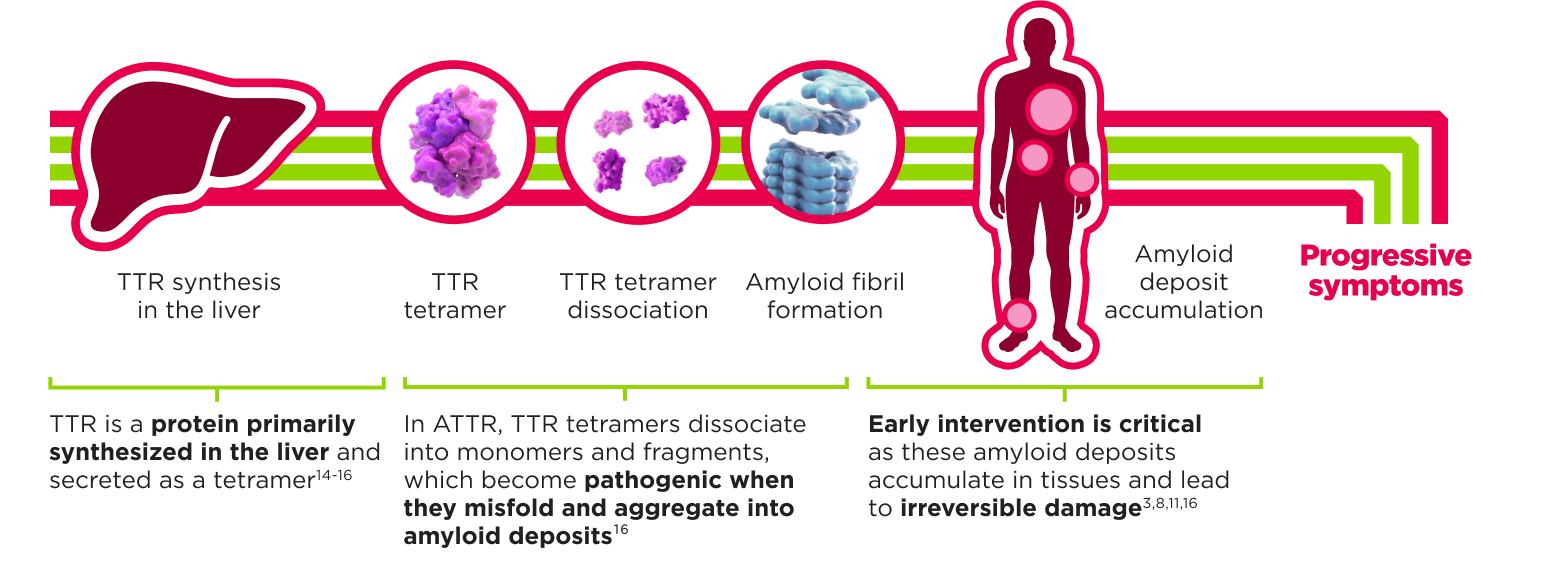
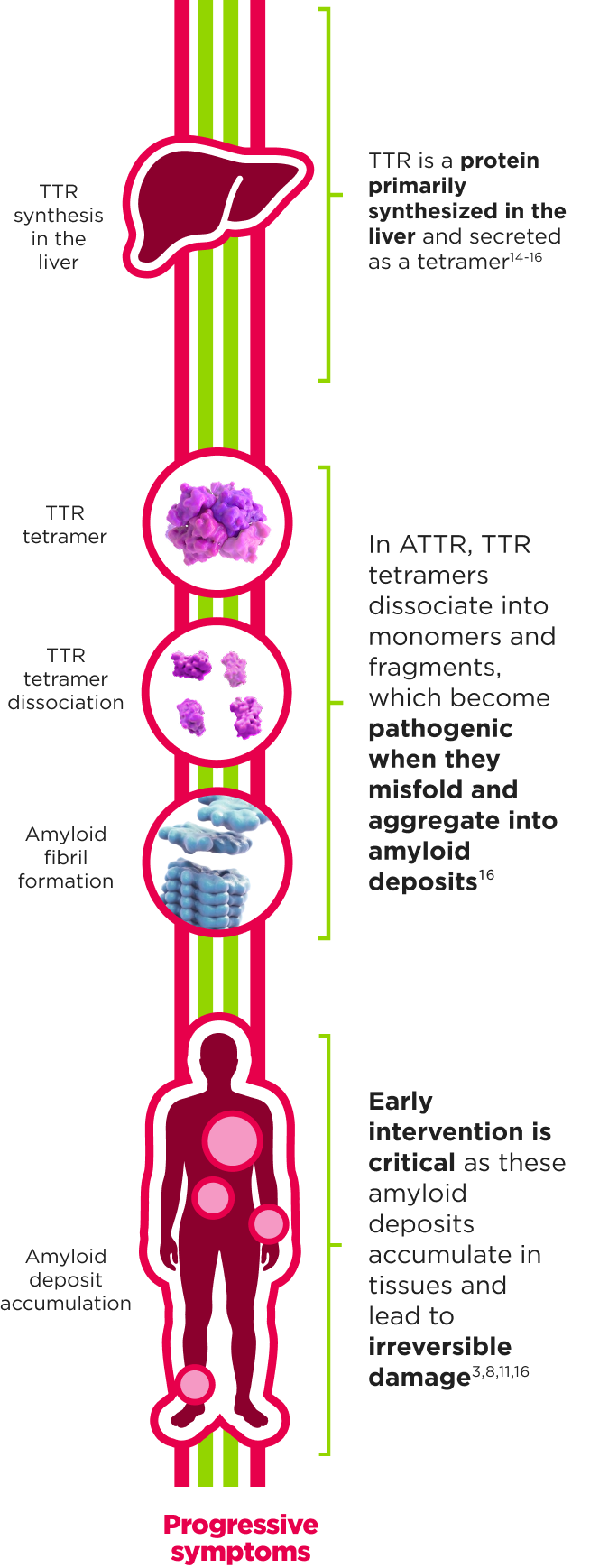
ATTR is a multisystem disease caused by pathogenic TTR10-13

Chart about progressive symptoms Chart about progressive symptoms

Cardiomyopathy is a common manifestation of ATTR (ATTR‑CM)
that may lead to heart failure.

Polyneuropathy, musculoskeletal manifestations, and other symptoms may also present11,13,17

Recognizing and diagnosing ATTR is critical2

There are 2 types of ATTR—wild-type (wtATTR) and hereditary (hATTR)

  • wtATTR is related to aging and typically manifests as cardiomyopathy. The etiology of wtATTR is unknown.3,18,19
  • hATTR is caused by a variant in the TTR gene and can manifest with cardiomyopathy and/or polyneuropathy. Patients with hATTR commonly experience both manifestations.3,18,19

Either type of ATTR can have a heterogeneous symptom presentation.8

The presence of these red flags may help identify patients with ATTR3

Heart icon

Cardiac

Unexplained left ventricular wall thickening in the absence of hypertension, HFpEF in combination with other noncardiac red-flag symptoms, conduction system disease/atrial fibrillation, intolerance to common CV/HF medications, elevated NT-proBNP20-25

Neurologic icon

Neurologic

Length-dependent neuropathic pain and weakness, altered sensation, difficulty walking, orthostatic hypotension, recurrent urinary tract infections, sexual dysfunction, sweating abnormalities, and urinary retention2

Spine icon

Musculoskeletal

History of musculoskeletal symptoms (eg, bilateral carpal tunnel syndrome, lumbar spinal stenosis, or biceps tendon rupture), past orthopedic surgery21,22

Gastrointestinal symptoms icon

Gastrointestinal manifestations

Diarrhea, constipation, nausea, vomiting, unintentional weight loss2

AMVUTTRA does not treat all of the symptoms of ATTR. AMVUTTRA is approved to treat ATTR-CM and hATTR-PN in adults.

ATTR=transthyretin amyloidosis; ATTR-CM=cardiomyopathy of transthyretin-mediated amyloidosis; CV=cardiovascular; hATTR-PN=polyneuropathy of hereditary transthyretin-mediated amyloidosis; HF=heart failure; HFpEF=heart failure with preserved ejection fraction; NT‑proBNP=N-terminal prohormone of brain-type natriuretic peptide; TTR=transthyretin.


Starting treatment at diagnosis is key to delaying disease progression footer
Starting treatment at diagnosis is key to delaying disease progression2

Stay informed

Receive more information about AMVUTTRA.

Connect with us

Find a treatment center

Locate a treatment center closest to your patients.

View the directory

Important Safety Information

Reduced Serum Vitamin A Levels and Recommended Supplementation

AMVUTTRA treatment leads to a decrease in serum vitamin A levels.

Supplementation at the recommended daily allowance (RDA) of vitamin A is advised for patients taking AMVUTTRA. Higher doses than the RDA should not be given to try to achieve normal serum vitamin A levels during treatment with AMVUTTRA, as serum vitamin A levels do not reflect the total vitamin A in the body.

Patients should be referred to an ophthalmologist if they develop ocular symptoms suggestive of vitamin A deficiency (e.g., night blindness).

Adverse Reactions

In a study of patients with hATTR-PN, the most common adverse reactions that occurred in patients treated with AMVUTTRA were pain in extremity (15%), arthralgia (11%), dyspnea (7%), and vitamin A decreased (7%).

In a study of patients with ATTR-CM, no new safety issues were identified.

For additional information about AMVUTTRA, please see the full Prescribing Information.

Indications

AMVUTTRA® (vutrisiran) is indicated for the treatment of the:

  • cardiomyopathy of wild-type or hereditary transthyretin-mediated amyloidosis (ATTR-CM) in adults to reduce cardiovascular mortality, cardiovascular hospitalizations and urgent heart failure visits.
  • polyneuropathy of hereditary transthyretin-mediated amyloidosis (hATTR-PN) in adults.

For additional information about AMVUTTRA, please see the full Prescribing Information .

References

  1. Hawkins et al. Ann Med. 2015;47(8):625-638.
  2. Conceição et al. Amyloid. 2019;26(1):3-9.
  3. Nativi-Nicolau et al. Heart Fail Rev. 2022;27(3):785-793.
  4. Vaishnav et al. JACC CardioOncol. 2026;8(2):120-136.
  5. Adams et al. J Neurol. 2021;268(6):2109-2122.
  6. Rozenbaum et al. Cardiol Ther. 2021;10(1):141-159.
  7. aus dem Siepen et al. Clin Res Cardiol. 2018;107(2):158-169.
  8. Lane et al. Circulation. 2019;140(1):16-26.
  9. Givens et al. Aging Health. 2013;9(2):229-235.
  10. Hanna. Curr Heart Fail Rep. 2014;11(1):50-57.
  11. Mohty et al. Arch Cardiovasc Dis. 2013;106(10):528-540.
  12. Adams et al. Neurology. 2015;85(8):675-682.
  13. Koike & Katsuno. Biomedicines. 2019;7(1):11.
  14. Soprano et al. J Biol Chem. 1985;260(21):11793-11798.
  15. Holmgren et al. Clin Genet. 1991;40(3):242-246.
  16. Bezerra et al. Front Mol Neurosci. 2020;13:592644.
  17. Coelho et al. Curr Med Res Opin. 2013;29(1):63-76. 2013;9(2):229-235.
  18. Ando et al. Orphanet J Rare Dis. 2013;8(1):31.
  19. Kourelis & Gertz. Expert Rev Cardiovasc Ther. 2015;13(8):945-961.
  20. Kittleson et al. Circulation. 2020;142(1):e7-22.
  21. Kittleson et al. J Am Coll Cardiol. 2023;81(11):1076-1126.
  22. Maurer et al. Circ Heart Fail. 2019;12(9):e006075.
  23. Dharmarajan K, Maurer MS. J Am Geriatr Soc. 2012;60(4):765-774.
  24. González-López et al. Eur Heart J. 2015;36(38):2585-2594.
  25. Brito et al. Global Heart. 2023;18(1):59.